RGB Desk Lighting: How to Light Your Setup Without Going Overboard
Lighting is the single fastest way to transform a setup from "fine" to "cinematic" — if you treat it as a layered system, not a colour explosion.
The three-layer rule
Every great-looking desk uses three lighting layers, the same way film directors light a scene. Skip any one of them and the setup either feels flat (no depth) or chaotic (too much going on). The layers are:
- Key light — the functional one. A desk lamp or monitor light bar that lets you actually see what you're doing.
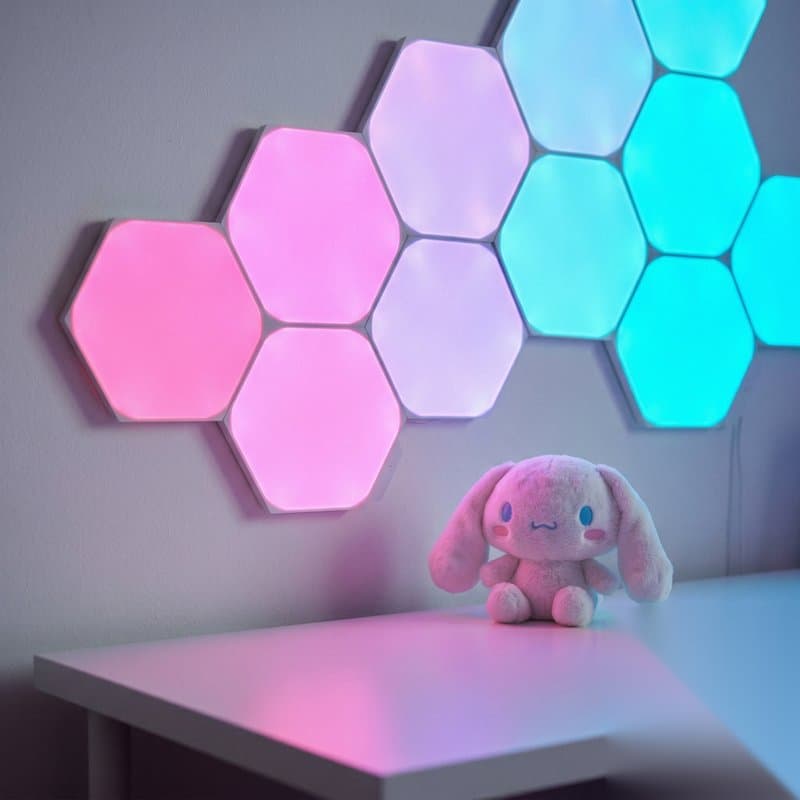
- Ambient fill — the mood one. Hex panels, an LED strip behind the monitor, a neon sign. This is the layer that makes the setup feel atmospheric.
- Accent — the personal one. A small pixel lantern, underglow on the desk, a backlit figure. Adds depth and warmth in close-up photos.
Three layers, two colours, one mood. That's the whole formula.
Layer 1: the key light
Your key light has to be functional first, decorative second. The two best categories for aesthetic setups:
- Monitor light bars (BenQ ScreenBar, Mi Computer Monitor Light Bar) — clip to the top of the monitor, light the desk without glaring into your eyes, almost invisible in photos. The premium aesthetic choice.
- Desk lamps with adjustable arms — a warm-white LED with a slim arm in cream, black, or matte gold. Looks like furniture, not a workplace fixture.
Avoid overhead ceiling lights for shooting — they cast harsh shadows that destroy the layered effect.
Layer 2: the ambient fill
This is where most aesthetic setups win or lose. The ambient layer fills the space behind the desk and gives photos their depth. Options, in rough order of impact:
- Hex light panels — Nanoleaf and Govee both make modular hex panels you can arrange in any shape. Highest visual impact per dollar. $60–150 for a starter kit.
- LED bias strip behind the monitor — a $20 USB-powered strip that glows around the back of the monitor. Subtle, atmospheric, easy to install.
- Neon-style sign or wire — single-colour acrylic neon (a word, a shape) that fits your palette.
- Smart light bulb in a textured lamp — a Hue or Govee bulb inside a paper or rattan shade. Soft, warm, ambient.
Layer 3: the accent
The accent layer is where personality lives. It's the layer that turns up in macro shots and makes a photo feel like your desk, not a generic catalogue.
- Pixel lanterns (like our Pixel Lantern) — small, glowing, sit on the desk surface, warm-light up close-ups.
- Underglow strips on the underside of the desk — visible only in low-light photos, hugely cinematic.
- Backlit figure or display piece — a single object that means something to you, lit from below.
- Candle-effect smart bulb in a small jar — flickering warm light, more cosy than cinematic.
The 2-colour rule
Whatever you do, lock in two colours across all three layers. Pick them from your overall desk palette (see our complete setup guide) and resist the urge to add a third or to set anything to rainbow cycle.
Combinations that consistently photograph well:
- Warm amber + dusty pink — cosy, golden-hour vibe
- Lavender + cool white — modern, slightly futuristic
- Mint + cream — fresh, cottagecore-meets-tech
- Deep purple + warm white — moody, dramatic, photographs cinematically
Set both colours to static or slow-breathing. Save the rainbow cycle for parties.
Common mistakes (and how to avoid them)
- Too much wattage. Aesthetic lighting is dim. If you can read a book by your ambient layer, it's too bright.
- Mixing warm and cool in the same shot. Pick one temperature family per setup. A 2700K warm lamp next to a 6500K cool fill looks broken.
- Overhead ceiling lights left on during photo shoots. Kills every layered light you have.
- One bright source, no fill. A single desk lamp casts harsh shadows. The fill layer makes shadows soft.
Frequently asked questions
How many lighting layers should I have?
Three: a key light, an ambient fill, and an accent. Three layers, two colours, one mood.
Should I avoid RGB completely?
No. The issue is rainbow cycling. Pick two static colours from your palette and RGB becomes one of your best aesthetic tools.
What colour temperature is best?
Warm white (2700K–3000K) for any task lamp. Ambient and accent layers can be coloured — just don't mix very warm and very cool in the same frame.
Are hex panels worth it?
Highest visual impact per dollar for the ambient layer. Watch the wall adhesive if you rent.
Do I need smart bulbs?
Not for the aesthetic. Smart bulbs are nice for scenes, but most aesthetic setups settle on 2 colours and rarely change them.
Shop the lighting collection
Lanterns, accent pieces, and ambient fills curated for layered desks.
Browse Lighting